Hybrid Business Strategy: Start in a Free Zone, Expand to Mainland
Quick summary: This guide explains the hybrid business setup strategy that's gaining traction among founders in Dubai, starting a company in a free zone to keep costs low, then expanding into the mainland once the business is ready to sell locally. You'll learn why this approach works, how Dubai's 2025 mainland-access reforms changed the rules, the exact steps to transition, what it costs, how corporate tax applies, and who this strategy suits best.
If you're weighing business setup in Dubai options and can't decide between a free zone and the mainland, you may not have to choose just one. A growing number of entrepreneurs are starting in a free zone and expanding into the mainland later, once revenue, team size, and market demand justify it. Here's how the strategy works in 2026.
What Is the Hybrid Business Strategy?
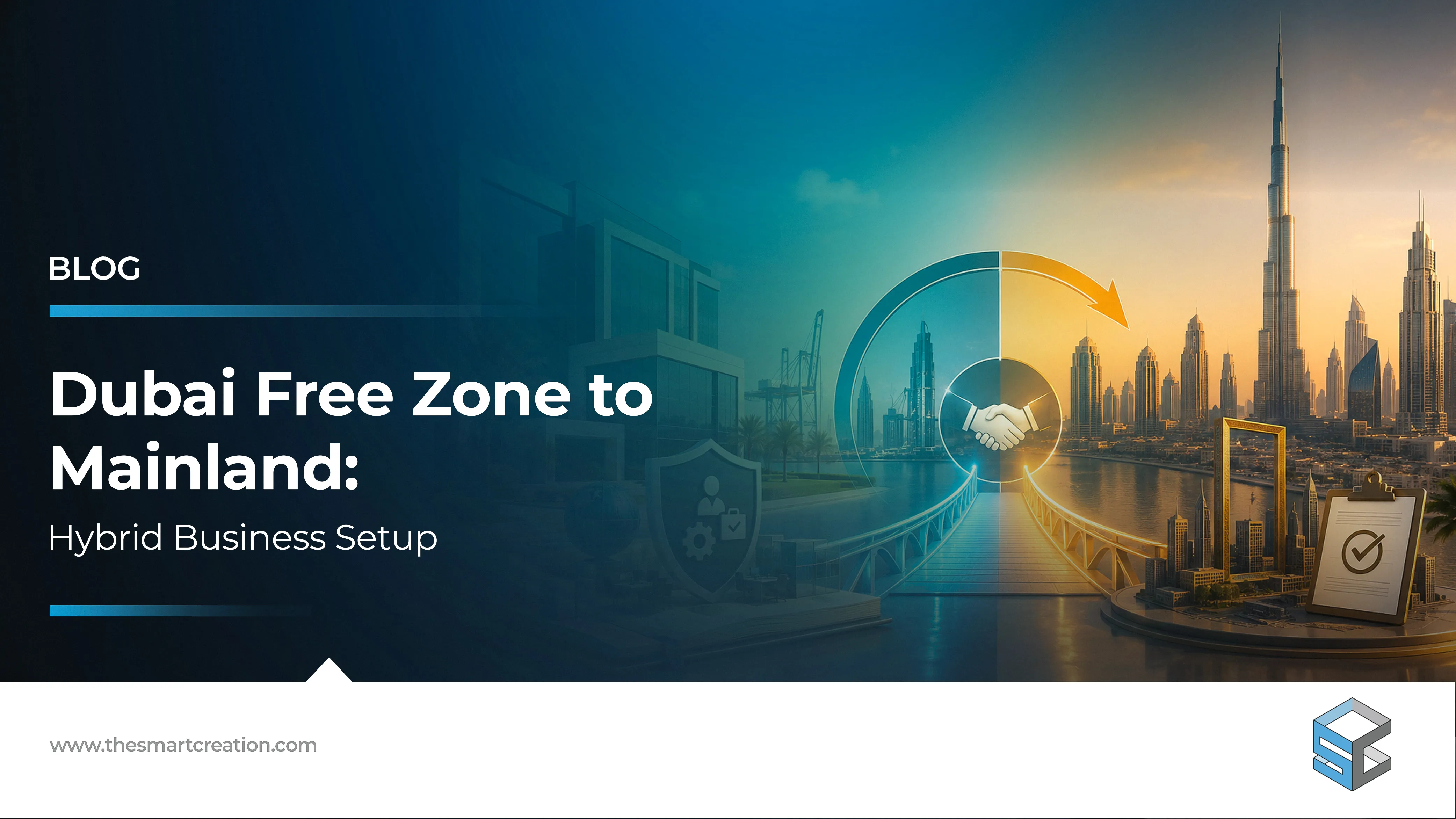
The hybrid approach is simple: register your company in a Dubai free zone first, then add mainland access once your business model requires it, usually to sell directly to UAE-based customers, bid on government contracts, or open a physical retail presence.
This isn't a workaround. It's now a formally recognized path thanks to recent regulatory reform, and it lets founders:
- Launch fast and cheaply with 100% foreign ownership
- Test their product or service in the market before committing to higher mainland costs
- Keep free zone tax advantages on qualifying income
- Add mainland trading rights only when the business is ready to scale
Why This Strategy Makes Sense Now
For years, free zone companies were boxed in: they could trade internationally and within their own zone, but selling directly to mainland customers meant going through a local distributor or setting up a separate mainland company from scratch. That made expansion expensive and slow.
That changed with Dubai Executive Council Resolution No. 11 of 2025, which came into effect in March 2025. For the first time, free zone companies in Dubai can apply for a license or permit to operate directly on the mainland, without dissolving their free zone entity, without a local distributor, and without a local sponsor.
Building on this, the Dubai Department of Economy and Tourism (DET) introduced the Freezone Mainland Operating Permit, which lets eligible free zone companies conduct mainland activities without setting up a brand-new legal entity at all. It currently covers non-regulated activities such as consultancy, technology, design, professional services, and trading, with regulated activities expected to be added over time.
In short: the wall between free zone and mainland hasn't disappeared, but it now has a door, and that door is what makes the hybrid strategy realistic for founders who want to start lean.
How the Transition Works: Free Zone to Mainland, Step by Step
Step 1: Get a No Objection Certificate (NOC) from your free zone authority
Your free zone (DMCC, IFZA, RAKEZ, Meydan, and others) needs to confirm it has no objection to your company operating beyond its jurisdiction. This is usually processed within a few days.
Step 2: Choose your mainland access route
You generally have two options:
- A branch license: valid for one year, renewable, suited to businesses planning ongoing mainland operations
- A temporary permit: valid for up to six months, ideal for testing mainland demand before committing further
Step 3: Match your mainland activity to your free zone license
The activities you conduct on the mainland must align with what's already listed on your free zone license. Expanding into new activities may involve additional fees.
Step 4: Apply through DET (or your local DED)
Submit your NOC, license copies, and required documentation. Processing typically takes a few weeks once paperwork is in order.
Step 5: Set up separate financial records
This is non-negotiable. Mainland-derived income and free zone income must be tracked in separate accounts, since they're taxed differently.
Step 6: Arrange your mainland workspace (if required for a branch)
Depending on the license type and activity, you may need a physical office to support your mainland operations and visa quota.
What Does It Cost?
Costs vary by free zone and activity, but as a general guide for 2026:
- Free zone setup: typically starts from a few thousand AED, with license issuance often possible within 3 to 10 working days
- NOC and mainland permit fees: temporary permits are a lower-cost way to test the market before paying for a full branch license
- Ongoing costs: separate bookkeeping, mainland office lease (if a branch requires one), and annual renewals on both the free zone and mainland side
This tiered cost structure is exactly why the hybrid model appeals to startups: you're not paying full mainland setup costs on day one.
Corporate Tax: What Changes When You Add Mainland Access
This is the part founders most often get wrong, so it's worth being precise:
- Your free zone income can still qualify for the 0% corporate tax rate if you meet Qualifying Free Zone Person (QFZP) conditions: substance requirements, qualifying activities, and arm's-length pricing.
- Any income earned from mainland activity is taxed at the standard 9% corporate tax rate (above the AED 375,000 threshold), regardless of your free zone status.
- Mixing the two income streams in one set of books can jeopardize your 0% rate entirely, which is why separate financial records aren't just a compliance formality, they protect your tax position.
Given how closely the Federal Tax Authority is now reviewing QFZP claims, this is an area where getting professional guidance before you expand pays for itself.
Pros and Cons of the Hybrid Strategy
Advantages:
- Lower upfront cost and faster launch through the free zone
- Full foreign ownership from day one
- Ability to test mainland demand via a temporary permit before committing
- Retains free zone tax benefits on qualifying income
- No need to liquidate or restructure your original entity
Trade-offs:
- Separate accounting and compliance obligations once you add mainland activity
- Mainland-derived income is taxed at 9%, so growth on that side increases your tax exposure
- Not every free zone activity currently qualifies for mainland permits, some regulated sectors are excluded
- DIFC-registered entities are not covered by this framework and follow separate rules
Who Should Consider This Strategy?
The hybrid approach tends to work best for:
- Startups and consultants testing the UAE market before scaling
- E-commerce and trading businesses that want to reach mainland customers without a full mainland entity
- Digital and professional service providers whose activities fall under the currently eligible categories
- Businesses expecting gradual growth, where paying full mainland costs immediately doesn't make financial sense
If your business model depends on retail storefronts, heavy government contracting, or activities not yet covered by the mainland permit framework, a direct mainland setup may still be the better starting point.
Build Your Business the Smart Way
Starting in a free zone and expanding into the mainland is no longer a compromise, it's a legitimate, cost-effective growth path in Dubai's current regulatory environment. But getting the sequencing, licensing, and tax structuring right from the start makes all the difference between a smooth expansion and a costly correction later.
At Smart Creation, we help entrepreneurs plan and execute exactly this kind of strategy, from your initial free zone company setup to a seamless mainland expansion when you're ready to grow. Whether you're just starting out or planning your next stage of growth in the UAE, our team can structure your business setup in Dubai for both cost efficiency today and flexibility tomorrow.
Get in touch with Smart Creation for a free consultation and find out which setup, free zone, mainland, or hybrid, fits your business goals.